Making your home more enjoyable on a daily basis relies on targeted modifications that transform the perception of a space without heavy renovations. Light, storage, materials, vegetation: each lever acts on a different sensory register. Here are ten concrete tips, also designed for households where multiple generations or lifestyles coexist under one roof.
1. Create a decompression zone right at the entrance
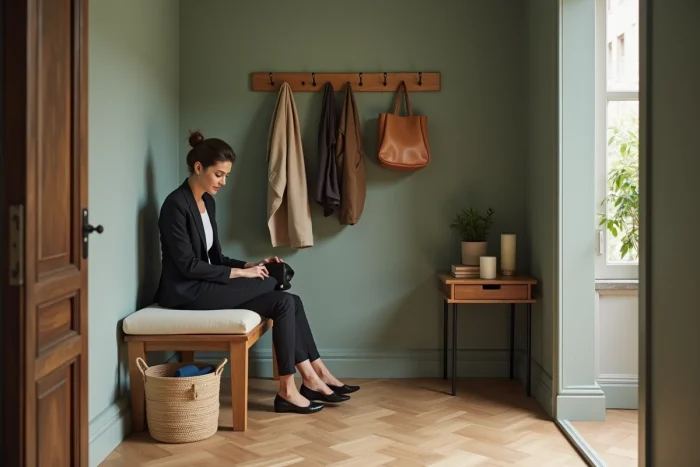
The entrance sets the tone. In a multi-generational home, it absorbs backpacks, keys, mail, and shoes of various sizes. Installing a low bench with integrated storage, a few hooks at different heights, and a wall pocket is enough to channel the flow.
The “Daily Home Comfort Survey 2026” by IFOP for IKEA France, conducted among 2,500 households, notes a decrease in feelings of mental overload among families that have adopted this type of minimalist space at the entrance. The principle: clear the mind as soon as you cross the threshold, even before reaching the living areas.
For those looking for more ideas on this topic, the home tips from Le blog de Bango offer additional suggestions tailored to different types of housing.
2. Adapt lighting to each room’s use
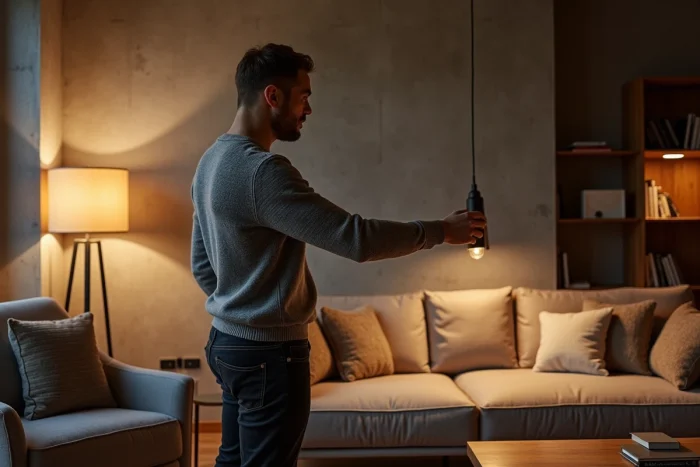
A single ceiling light produces flat lighting that strains the eyes. Multiplying sources (reading lamp, low-voltage garland, wall sconce) allows you to modulate the atmosphere according to the time of day.
In a living room shared between a teenager working and a parent relaxing, two independent lighting circuits prevent conflicts. Adaptive lighting management systems, increasingly accessible, automatically adjust the color temperature between cool light (concentration) and warm light (rest).
3. Integrate purifying plants following the biophilic approach
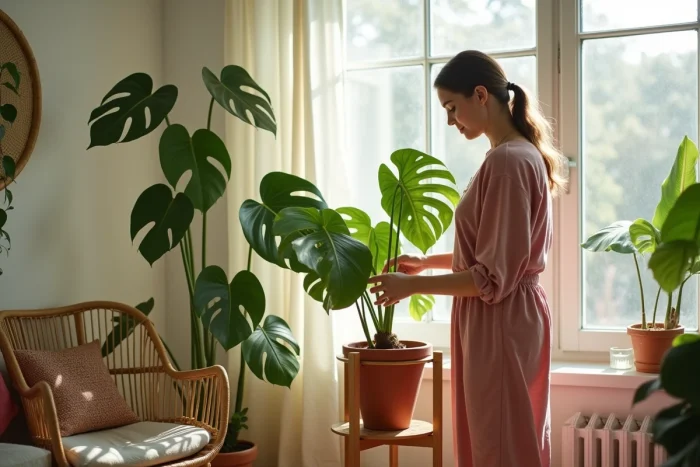
The mere presence of plants changes the perception of a space. The study “Biophilic Design Impact on Well-being,” published in the Journal of Environmental Psychology (vol. 85, February 2026), shows that the biophilic approach reduces stress measured in residential environments more significantly than mere organization.
Specifically, three to five plants distributed between the living room and kitchen are sufficient. Pothos, peace lily, and spider plant tolerate missed watering, making them suitable for households where no one takes on the role of “designated gardener.”
4. Work with colors in blocks rather than entire walls
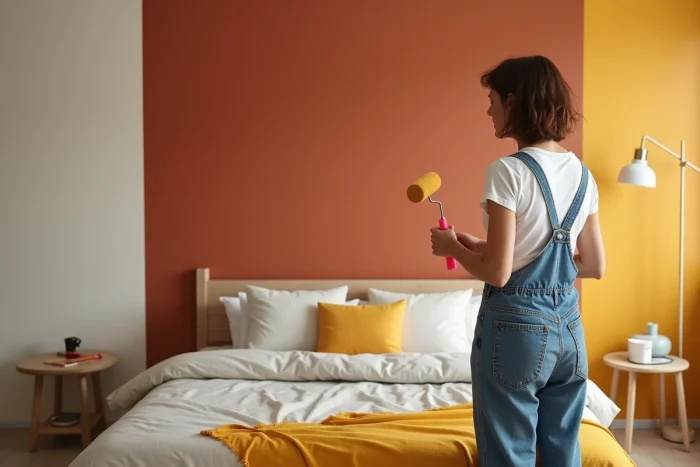
Painting an entire wall in a bright color can overwhelm a small space. A more flexible alternative is to apply color to a defined block: a half-height wainscot, the inside of a niche, the back of a shelf.
This technique allows you to test a shade without total commitment. In a shared house, each occupant can personalize a block in their room without affecting the coherence of common spaces. Muted tones (sage green, terracotta, blue-gray) remain the easiest to integrate.
5. Declutter through seasonal rotation
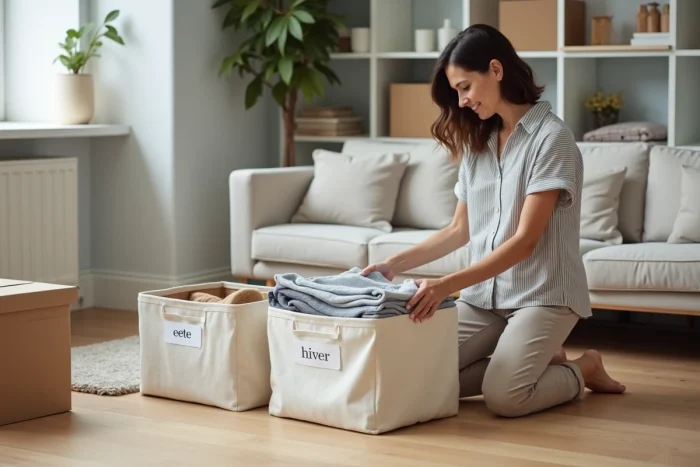
One-time and radical sorting rarely works in the long run. A system of seasonal storage rotation yields better results: each quarter, a box of unused items is set aside. If it hasn’t been opened after six months, its contents are donated or recycled.
For multi-generational households, this method avoids tensions related to imposed sorting. Each person manages their own rotation at their own pace.
6. Invest in quality textiles for bedding and curtains
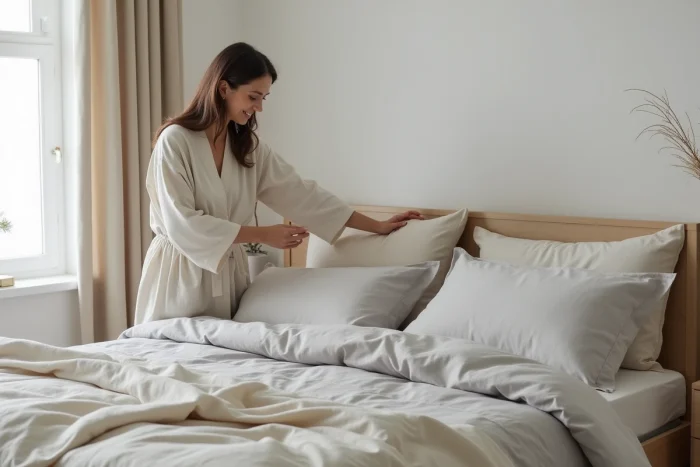
Textiles are the first physical contact with the interior. Sheets made from tightly woven cotton or washed linen immediately change the feeling of going to bed. Curtains, often overlooked, filter light and absorb street noise.
Prioritizing breathable natural materials (linen, cotton, hemp) also improves the thermal regulation of the room, a valuable point when temperature preferences differ among occupants.
7. Optimize the kitchen with vertical storage
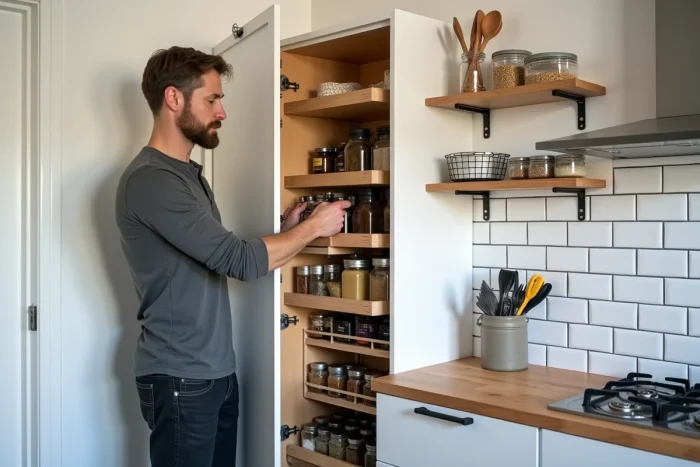
The kitchen is the most used room in a shared home. Cluttered countertops slow down preparation and create visual disorder.
- Wall-mounted magnetic bars free up drawers by holding knives and metal utensils.
- Open shelves above the countertop make common ingredients accessible without opening a cabinet.
- Hooks under high shelves utilize dead space to hang mugs or small pots.
Switching from horizontal to vertical storage can free up to a third of the available countertop space.
8. Introduce natural ambient sounds to reduce household noise

Background noise (television, conversations, appliances) is an underestimated source of fatigue. A small indoor fountain or a speaker playing nature sounds (rain, stream) creates a sound masking that dampens distracting noises.
In a home where multiple life rhythms coexist, this tip allows one person to concentrate in the living room while another cooks nearby. The cost remains modest, and the effect on the perception of calm is quick.
9. Automate a repetitive household task

Automation is not just for technology enthusiasts. A robot vacuum programmed to run every morning while the household has breakfast eliminates a daily chore without conscious effort. Current self-emptying models require only monthly maintenance of the bin.
The report “Smart Home Trends 2026” from Statista confirms the trend towards integrating these devices for passive comfort that lightens the domestic mental load. For a multi-generational household, the time savings benefit everyone without imposing any particular technical skill.
10. Enhance decoration through forgotten senses: touch and smell

Decoration is often thought of visually. Touch (a wool blanket on the sofa, a long-pile rug underfoot) and smell (handmade candle, essential oil diffuser) complete the sensory experience of an interior.
Varying textures within a single room (raw wood, ceramics, fabric) creates a tactile richness that makes the space more welcoming. For smell, using only one fragrance per room avoids saturation, especially in shared spaces where olfactory sensitivities differ.
These ten tips require neither a significant budget nor DIY skills. Their common point: acting on multiple sensory registers rather than just the visual aspect. In a home where different profiles coexist, this multi-sensory approach offers everyone a lever for personal comfort without encroaching on that of others.