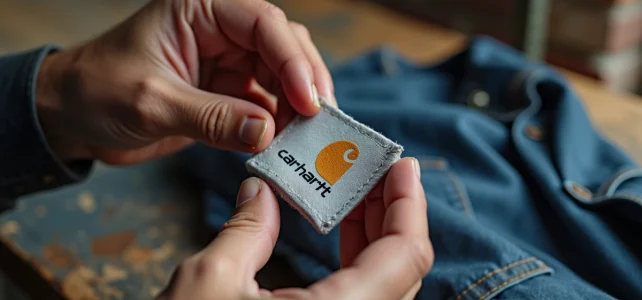
When buying a Carhartt beanie on Vinted, the tag seems correct, the logo is well-placed, and the price matches the second-hand market. Two weeks later, a buyer to whom we resell the item reports it as a fake. This problem is not rare, and it does not only concern collectors: in the secondary market, the majority of Carhartt counterfeits pass through the hands of well-meaning sellers who have never learned to closely read a tag.
Lockstitch and fabric weight: details that counterfeiters overlook
Authentication guides focus on the embroidered logo and the typography of the tag. A more reliable marker is often overlooked: the internal lockstitch. On an authentic Carhartt garment, the internal seams use a tight, regular knot stitch with thick thread that withstands tension.
Low-cost counterfeits replace this stitch with a basic overlock, which is looser and forms visible loops on the back of the fabric. To check, turn the item inside out and observe the side seams in the light. A knot stitch forms two well-tensioned parallel threads. An overlock shows chain loops.
The fabric weight also provides a direct indication. Authentic Detroit jackets use a dense enough canvas to stand up when folded. If the fabric wrinkles easily between two fingers like a lightweight shirt, the item deserves a closer inspection. To deepen these checks, you can recognize an authentic Carhartt tag by cross-referencing several physical criteria rather than relying on a single element.

Carhartt tag: typography, positioning, and NFC chip
The tag remains the first reflex, and rightly so. On a Carhartt workwear piece, it is sewn into the collar or on the left inner pocket. The typography of the word “Carhartt” uses a proprietary font with a distinctive “C” and consistent letter spacing.
What to check in under thirty seconds
- The embroidered logo on the main tag must have sharp edges, with no loose threads. On fakes, the embroidery often has a blurry outline or irregular stitches at the “C” and the final “t”.
- The size tag, sewn under the main tag, indicates a style number (product reference). This number must correspond to an existing model in the Carhartt catalog. A quick online search is enough to verify it.
- On recent Carhartt WIP pieces, a QR code or NFC chip is integrated into the tag. Counterfeiters sometimes replicate these elements, but the QR codes redirect to mirror sites instead of the official domain carhartt-wip.com.
- The background color of the tag varies by line (American workwear, European WIP, collaborations). A black tag on a model that should have a brown tag indicates an inconsistency.
Feedback varies on the reliability of basic NFC scans. Counterfeiters now replicate functional chips, making a simple scan with the phone insufficient. Always check that the link points to an official Carhartt domain, not a copy.
Differences between Carhartt workwear and Carhartt WIP: two tags, two markets
Confusing the two lines is the most common source of error in resale. Carhartt workwear and Carhartt WIP are two distinct brands, with separate tags, cuts, and distribution channels.
The American workwear line features a rectangular tag with the “C” logo in gold embroidery on a dark brown background. Recent models include a barcode and a readable style number. Carhartt WIP, the European streetwear-oriented line, uses a finer woven tag, often black or white, with tighter typography.
A seller offering cargo pants labeled “Carhartt WIP” with an American workwear-type tag is either selling a fake or a recomposed piece. Cross-referencing the product reference with the catalog of the correct line takes less than a minute and eliminates the majority of blatant fakes.
Reselling counterfeit Carhartt on Vinted: what the law says
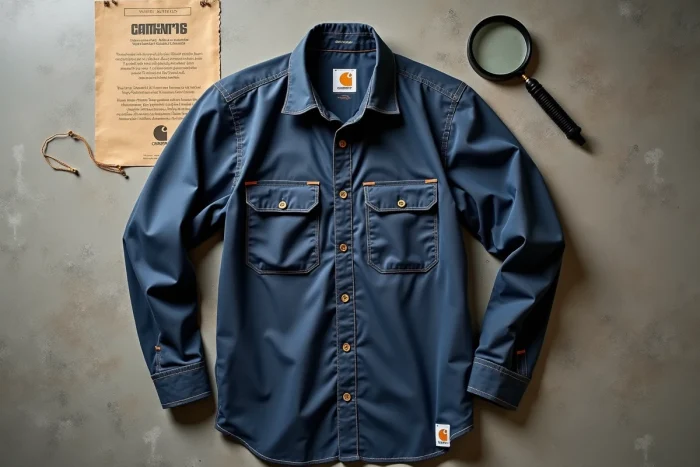
Reselling a fake Carhartt, even purchased in good faith, exposes the seller to legal consequences. French law equates the sale of counterfeit goods to an offense, regardless of whether the seller is aware of the product’s nature. Platforms like Vinted or Leboncoin can suspend an account after a report, without a contradictory procedure.
In practice, criminal prosecutions against individuals remain rare. The most common risk is a refund request through the platform’s buyer protection, accompanied by a report that affects the seller’s account reputation.
Three reflexes before listing a second-hand Carhartt piece for sale
- Photograph the main tag, the size tag, and the internal seams. These photos serve as proof of good faith in case of a dispute.
- Check the style number on the official Carhartt or Carhartt WIP website. If the reference does not match any existing model, do not list the item for sale.
- Keep the original proof of purchase (receipt, screenshot of the transaction). It helps demonstrate that the purchase was made without fraudulent intent.
These precautions do not guarantee total protection, but they are sufficient to demonstrate the seller’s good faith in the vast majority of disputes on resale platforms.
Authenticating a Carhartt piece relies on a bundle of clues, not a single criterion. Tag, stitching, fabric weight, consistency between the product line and the type of tag: each check taken in isolation can be circumvented by a careful counterfeiter, but their accumulation makes detection reliable. Before reselling, take the thirty seconds needed to document the item. It is the only investment that protects both the seller and the buyer.