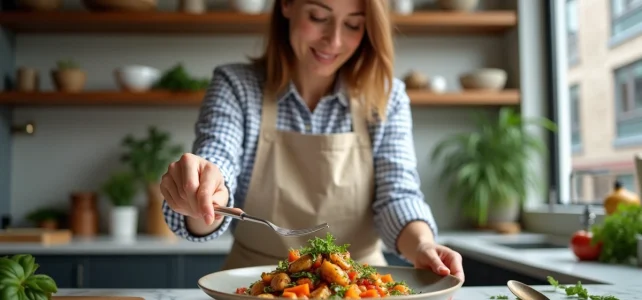
The kitchen trends in 2026 are no longer just about color choices or handles. They reflect a deeper shift: the kitchen is abandoning its status as a technical room to become a hybrid space, both functional and decorative, adaptable to everyday uses. Understanding these evolutions requires distinguishing between material, form, and spatial organization.
Textured facades and matte finishes: the vocabulary of materials is changing
For several years, very smooth, lacquered, and ultra-white kitchens dominated catalogs. This cycle is coming to an end. Manufacturers are shifting their offerings towards more tactile and natural surfaces: raw or veined wood, reconstituted stone, matte sandy finishes, fluted facades.
Marble remains present, but it is used differently. It is found as a backsplash or in narrow countertops rather than in a total look. Matte black, long reserved for high-end kitchens, is becoming more common on facades and faucets.
This shift towards warmer materials responds to a simple logic: in an open kitchen that connects to the living room, surfaces must interact with the living room furniture. A brushed oak or ceramic stone facade integrates better than a glossy lacquered panel next to a linen sofa. To follow the news from Conseils Cuisine, this connection between kitchen materials and living room furniture codes is one of the key themes of the season.

Concealed kitchen: what this design trend really hides
The concealed kitchen is the most talked-about concept this year. The principle: integrate appliances, storage, and countertops behind uniform facades, sliding doors, or flush panels. When everything is closed, the room resembles a living room.
This approach goes beyond minimalist aesthetics. It is based on a concrete architectural constraint. In recent housing, the open kitchen has become the norm. The concealed kitchen allows for masking visual clutter (dishes, small appliances, recycling bins) without reverting to a closed kitchen with a partition.
What this implies in terms of design
Concealing a kitchen requires precise technical choices:
- Appliances must be built-in and dressed, which requires standard dimensions or costly custom solutions.
- Opening systems (push-to-open, retractable doors) replace handles, directly impacting the hardware budget.
- Ventilation must be rethought, as an invisible or integrated hood does not provide the same airflow as a traditional hood.
The concealed kitchen is a comprehensive design project, not just a simple facelift of facades. Without technical foresight, the result may prove less functional than a well-organized traditional kitchen.
Deep colors and bold contrasts: the end of all-neutral
White and light gray are not disappearing, but they are losing their monopoly. The editorial lines of kitchen designers for 2026 show a rise in deep shades: sage green, midnight blue, terracotta, dark burgundy. These colors appear on low facades, islands, or niches, rarely on all the furniture.
The principle of contrast structures this approach. A dark-colored island placed in front of light-colored upper cabinets creates a visual depth that monochrome does not offer. It is a play of volumes through color rather than just a decorative desire.
Two-tone facades often combine with brushed brass or matte black details on faucets and handles, when they still exist. This “signature” style marks a clear departure from the standardized models offered in mass distribution.
Multifunctional island and modular space: rethinking everyday use
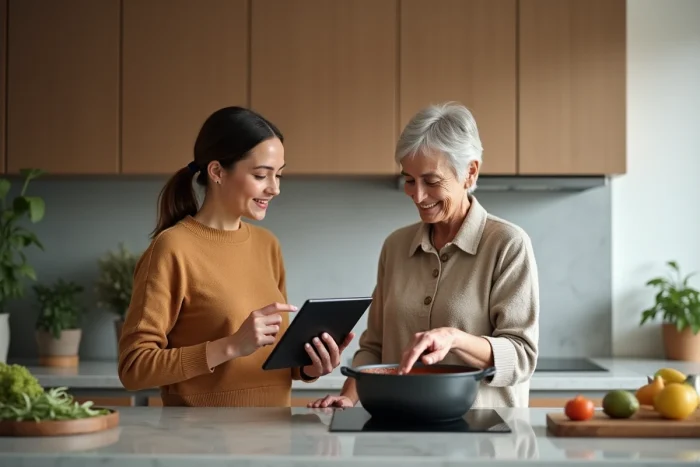
The central island is not a novelty. What is changing is the range of functions attributed to it. Recent models integrate cooktops, refrigerated storage, USB ports, and sometimes a raised countertop that serves as a makeshift desk.
This versatility reflects a post-2020 reality: the kitchen accommodates activities that are not culinary. Occasional remote work, children’s homework, standing aperitifs with friends. The island becomes the pivot of these cross-functional uses.
Modularity: a term that encompasses very different realities
Some manufacturers offer wheeled modules or repositionable blocks. Others use the term modularity simply to refer to a drawer with interchangeable compartments. Before choosing, it is essential to clarify what “modular” means in the consulted catalog:
- A mobile island (on brakes) can be moved but requires flexible connections for water and electricity.
- A fixed island with removable trays offers usage flexibility without technical constraints.
- Reconfigurable internal shelving systems allow for storage adaptation without altering the furniture.
Real modularity, the kind that allows for space transformation, remains limited to custom-designed kitchens or high-end ranges. In entry-level offerings, the term often refers to interchangeable accessories.
Rounded lines and organic shapes: a lasting aesthetic shift
Right angles are receding. Facades with rounded edges, countertops with softened corners, and furniture with curved lines are multiplying in the 2026 catalogs. This is not just a matter of style: rounded shapes modify circulation in the room and reduce the risk of collisions in tight spaces.
This shift is part of a broader movement in interior design, where organic shapes replace strict geometries. In kitchens, this translates to oval islands, hoods with pronounced curves, and sculpted handles reminiscent of mid-century furniture.
Practicality follows visual appeal. A facade without sharp angles accumulates fewer fingerprints and is easier to clean than a panel with protruding edges. The gain is modest but real in daily life.
This year’s kitchen trends share a common point: they start from usage before discussing decor. Materials that age better, storage that disappears, islands that serve multiple purposes, colors that structure the space. Choosing a kitchen in 2026 resembles more of an architectural decision than a selection from a color chart.