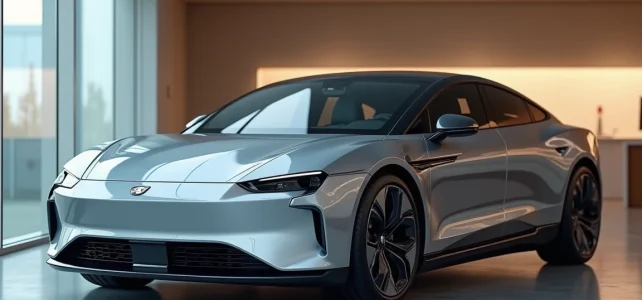
Centralized electronic architectures have redefined the relationship between manufacturer and customer in 2024. The vehicle is no longer fixed upon leaving the factory: it evolves through software updates, sometimes months after delivery. This shift towards the software-defined vehicle is the major technical fact of the year, far more significant than the launch of any particular model.
Software-defined vehicle: centralized architectures that change the game in 2024
Volkswagen has rolled out its E3 2.0 architecture, Stellantis has introduced STLA Brain, and Hyundai-Kia has launched ccOS. These three platforms share a common principle: a single OS controls the majority of the vehicle’s functions. Sensors, infotainment, battery thermal management, driver assistance – everything feeds into a central computer instead of being scattered across dozens of independent boxes.
The direct consequence for the user is the OTA (over-the-air) update. Stellantis, with STLA Brain, has designed its architecture so that features can be added or modified long after the sale. Here we see a change in the business model: the manufacturer no longer sells just a physical object; it maintains a continuous software relationship.
This shift comes with a massive industrial cost. Developing a proprietary OS requires hiring thousands of software engineers and rethinking validation chains. Manufacturers that do not have this capability in-house rely on partnerships with cloud and AI players, which redistributes power within the industry.
To closely follow these developments, automotive news on Je veux de l’info regularly covers the technical announcements from manufacturers and their concrete implications.

Embedded generative AI: voice assistants and diagnostics in the cabin
The integration of generative language models in the cabin reached a milestone in 2024. Mercedes-Benz expanded its voice assistant by combining Alexa with a conversational model capable of responding to complex queries, not just changing the radio station.
BMW and Stellantis have taken different approaches. BMW announced a partnership with Amazon, while Stellantis partnered with Amazon and Cerence to develop AI assistants capable of explaining the user manual or offering a pre-diagnosis from the central screen. The idea is no longer to dictate short commands but to converse with the vehicle in natural language.
We recommend distinguishing two levels of integration in these announcements:
- The infotainment level, where AI manages navigation, music, and general queries – already functional on several models delivered in 2024
- The technical diagnostic level, where the assistant interprets a warning light and suggests corrective action – still limited to simple scenarios
- The planning level, where AI proposes an optimized route considering range, available charging stations, and real-time traffic – announced but not yet widely deployed
The promise is strong, but the reliability of these systems in real-world conditions remains to be proven over the long term. An assistant that makes a mistake on an engine diagnosis poses a liability issue that manufacturers have not yet publicly resolved.
Solid-state batteries for electric vehicles: where is the technology really at?
Solid electrolyte batteries have moved from the laboratory stage to the pre-industrial stage in 2024. Several manufacturers have communicated about functional prototypes, with known theoretical advantages: higher energy density, reduced weight, better thermal stability compared to conventional liquid electrolyte lithium-ion cells.
In practice, mass production remains a challenge. The manufacturing processes for solid electrolyte layers at an industrial scale are not yet stabilized. The unit cost remains significantly higher than that of current NMC or LFP cells.
What has changed in 2024 is the credibility of the announced timelines. Toyota, which has been working on this technology for a decade, confirmed road tests with cells close to the final specification. The challenge is no longer to prove that the chemistry works, but to produce it at an acceptable cost.
Autonomous driving and regulatory framework: concrete advances in 2024
The European regulatory framework evolved in 2024 with the implementation of new obligations related to the GSR2 regulation. Advanced driver assistance systems (ADAS) of level 2+ have become widespread in new models, featuring improved emergency braking, active lane keeping, and driver monitoring via infrared camera.
Level 3 autonomous driving, where the vehicle takes over under defined conditions and the driver can divert their attention, remains limited to a few high-end models and specific scenarios (traffic jams on highways, reduced speed). No manufacturer has commercialized level 4 in Europe in 2024.
We observe an increasing gap between marketing discourse, which suggests near-total autonomy, and technical reality. Current systems remain driver assistance tools, not substitutes for the driver. Legal responsibility in the event of an accident during a level 3 autonomous phase is not harmonized among European countries.
Plug-in hybrids and thermal: a market that resists predictions
Sales of hybrid vehicles (both mild and plug-in) continued to grow in 2024, often at the expense of fully electric vehicles. The high purchase costs of electric vehicles, combined with an uneven charging infrastructure across regions, have pushed many buyers towards intermediate solutions.
The plug-in hybrid meets a concrete need that the market has not managed to address otherwise: driving electric daily over short distances while retaining a thermal engine for long trips. Manufacturers have expanded their PHEV ranges accordingly, sometimes reallocating budgets initially intended for 100% electric platforms.
The thermal engine, for its part, has not disappeared from catalogs. Several European markets still show a majority of sales in gasoline or diesel, particularly in the utility and mid-range SUV segments. The energy transition of the automotive fleet remains a slow process, conditioned as much by economics as by technology.
The automotive landscape of 2024 is characterized by a tension between technological acceleration and market caution. Software components and AI are advancing rapidly, solid batteries are nearing series production, but consumers still largely decide based on price and daily use.