
Glass breakage during moving rarely results from a frontal impact. In the majority of incidents, it is a lateral impact, an unanticipated flex, or insufficient padding in the vehicle that causes the crack. Here, we address the technical points that general guides overlook, starting with the most challenging case: old buildings with narrow access.
Windows in Haussmannian buildings: managing lateral shock in narrow access
Haussmannian staircases impose right-angle turns with a usable width often less than 80 cm, including handrails. Any glass or large window transported vertically experiences lateral stresses with every change of direction.
The first reflex is to measure each passage before the big day: width of the carriage door, curvature radius of the landing, ceiling height at the half-floors. A pane that theoretically fits may block in practice if the pivot angle has not been calculated.
We recommend protecting the edges of the glass with closed-cell polyethylene profiles, cut to the exact length. These profiles absorb contacts with stone or wrought iron railings, where bubble wrap alone tears at the first friction. The edge is the most vulnerable area of a pane in transit, as a localized impact on the edge triggers a crack that propagates across the entire surface.
For large windows, the technique of carrying in pairs with professional suction cups remains the only reliable option in a narrow staircase. Pump suction cups (not just adhesive ones) provide a stable grip even on wet or dusty glass. The rear carrier guides trajectory corrections, while the front carrier manages the tilt.
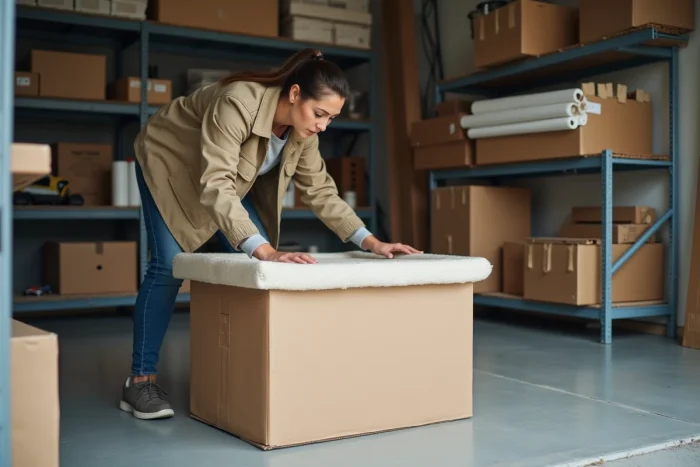
Tape and holding film: installation technique on glass surfaces
Applying cross Saint Andrew’s tape on a pane before transport is not a symbolic gesture. This technique limits the spread of cracks in case of shock: the tape keeps the fragments attached to the frame instead of allowing them to shatter. To protect the glass during a move, the choice of tape is as important as the action.
Use medium-adhesion masking tape, not standard packing tape. Masking tape (painter’s type, 48 mm wide) removes without residue and without risking peeling a surface treatment. Brown tape leaves a sticky residue that requires a solvent, with a risk of scratching the glass when scraping.
The application follows a precise pattern:
- Two diagonal strips from corner to corner, forming an X across the entire glass surface.
- A horizontal strip in the center, where the flex is maximal on large formats.
- On double glazing, apply only to the outer face (the inner face is protected by the air gap that absorbs part of the shock wave).
A food stretch film or a protective film for glazing can complement the tape. Stretched across the entire surface, it adds a layer of retention for shards without weighing down the piece.
Packing in the truck: tilt and distribution of supports
Transporting flat is the primary cause of breakage in vehicles. A pane laid horizontally bears its own weight across its surface, generating enough flex to crack large formats at the first sudden slowdown.
Always transport a pane in a vertical position, tilted between 10 and 15 degrees against a rigid wall of the vehicle. This slight tilt presses the pane by gravity against its support, without constantly stressing the lateral pads.
Packing requires a minimum of three points of support:
- A thick moving blanket between the pane and the wall of the truck, to absorb road vibrations.
- High-density foam pads on the ground, under the lower edge, to avoid direct glass/metal contact.
- A ratchet strap passed over the protection, fixed to two distinct anchor points of the vehicle, with enough tension to hold without compressing.
We observe that individuals often make the mistake of tightening the strap too much. A pane is not a piece of furniture: the strap should hold, not compress. Excess tension creates a localized pressure point that can be enough to initiate a crack, especially on old single glazing.
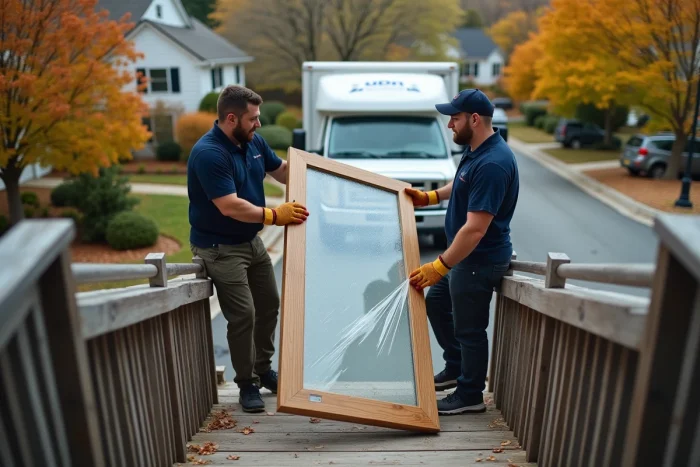
Protection of window panes still mounted on frames
When the glass remains in its frame (full window, French door, sliding bay), the protection adapts. The frame absorbs some of the stresses, but it introduces an additional risk: the play between the glass and the frame can increase under transport vibrations, causing repeated micro-shocks.
The solution is to fill this play with adhesive foam strips inserted between the glazing and the rebate. On old wooden frames, this play can sometimes reach several millimeters, enough for the glass to “bang” against the wood with every bump.
For large bays (over one and a half meters in height), we recommend making a protective frame from battens temporarily screwed onto the frame. This frame extends a few centimeters beyond the glass surface and absorbs contacts with other objects in the truck. The over-frame in battens transforms a fragile object into a manageable package.
After installing the frame, wrap the entire assembly in a moving blanket secured with stretch film, leaving a marked area labeled “GLASS” visible with a marker. Labeling prevents another handler from stacking a heavy box against the glass surface during loading.
The final point to check concerns handles and locks that protrude from the frame. Remove them or protect them with foam secured with masking tape. An unprotected lock catches on blankets, destabilizes the grip, and can scratch the adjacent glass in the truck.