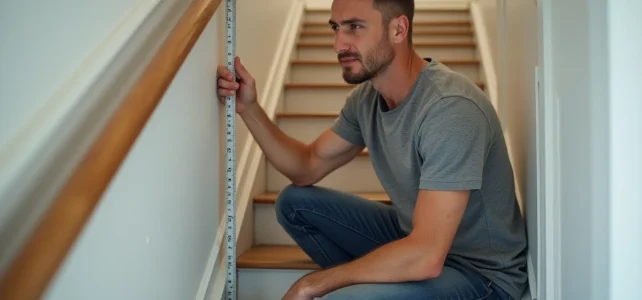
An L-shaped sofa delivered on a Saturday morning, two sweaty delivery men in the stairwell, and the furniture that refuses to cross the threshold of the second floor. This scenario costs time, money, and sometimes leads to a complete return. The problem almost never comes from the furniture itself, but from a measurement forgotten or mistaken before the purchase.
Knowing precisely whether a piece of furniture can fit in a staircase relies on three or four targeted measurements, not on a rough estimate.
Diagonal measurement of the furniture: the figure everyone forgets
We instinctively think of the width and height of a piece of furniture. These two dimensions are not enough. When tilting a sofa or a wardrobe to negotiate a turn, it is the diagonal depth that determines whether the furniture passes. This measurement corresponds to the distance between the lower back corner and the upper front corner of the furniture, viewed from the side.
To calculate it without a complicated formula, place the furniture against the wall, and run a tape measure from the floor (at the deepest point of the seat or back) to the top of the backrest or the front panel. It is this diagonal that needs to be compared to the usable width of the staircase, not the raw depth of the furniture.
Before any online purchase, it is essential to check if a piece of furniture can fit in a staircase by comparing this diagonal to the actual dimensions of the passage. Without this step, we are playing heads or tails on delivery day.
Usable width and ceiling height in the staircase: where to measure exactly
The width of a staircase is not measured between the walls, but between the actual obstacles. A fixed handrail, a protruding radiator, a thick handrail reduce the passage space by several centimeters. Always measure between the most protruding elements, not between bare walls.
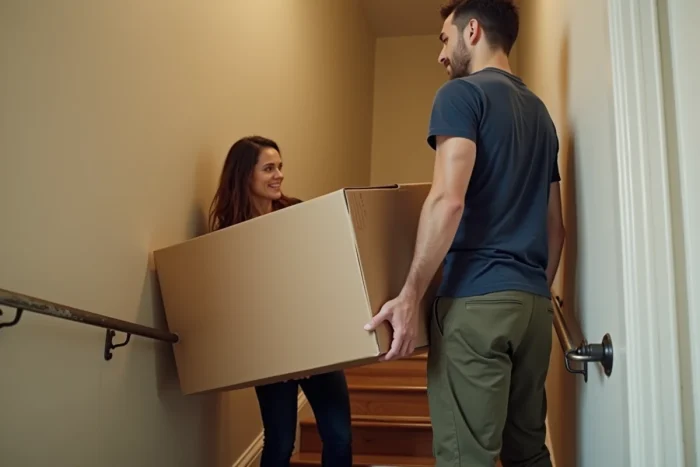
Ceiling height also matters, especially in older buildings where the underside of the upper flight descends low at the intermediate landing. A piece of furniture held vertically can bump against the sloping ceiling above the steps. You need to measure the free height at the lowest point of the passage, often located at the beginning or end of the flight.
Here are the measurement points not to be overlooked:
- Width between the handrail and the opposite wall (or between two handrails), allowing for a margin of at least two centimeters on each side.
- Ceiling height at the most constrained point, usually directly above the intermediate landing or under the upper flight.
- Depth of the resting landing or turning landing, which determines the available space to pivot the furniture.
- Width of the apartment’s front door, often the final bottleneck checked last while it blocks first.
Turning staircase and narrow landing: the critical turning zone
A straight staircase rarely poses a problem if the raw dimensions are compatible. The real filter is the turn. In a quarter-turn or half-turn staircase, the furniture must pivot in a constrained space in three dimensions. The maneuver depends on the depth of the landing and the angle of the elbow.
On a classic quarter turn, there is a 90-degree angle. The furniture must be able to tilt from a horizontal position (parallel to the steps) to a perpendicular position, or stand upright if the height allows. For a half-turn at 180 degrees with a central landing, it is the length of the landing that limits the maximum size of the transportable furniture.
A simple technique: mark the surface of the landing on the floor with tape, then transfer the dimensions of the furniture (diagonally) onto this outline. If the furniture, even tilted, overflows the available rectangle, it will not pass without disassembly.
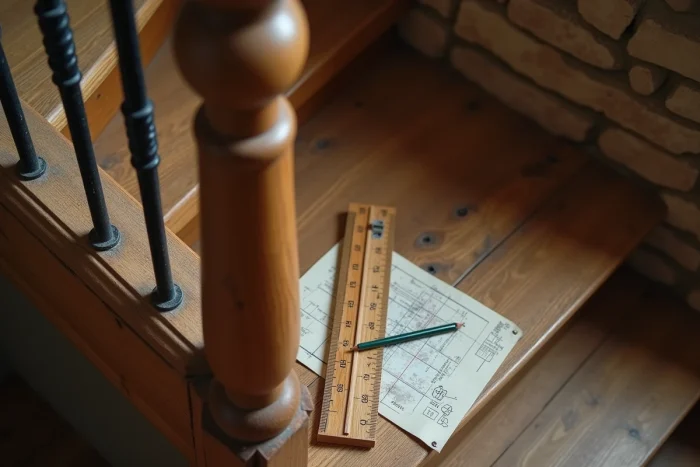
The staggered step staircases and space-saving models complicate matters even further. The alternating step depth alters the actual maneuvering angle and reduces the area where a bulky piece of furniture can be tilted, even when the opening seems sufficient on paper.
When the furniture doesn’t fit: alternatives before giving up
The realization comes after verification: the diagonal exceeds the usable width by a few centimeters, or the turning landing is too short. Before changing the furniture, several options deserve to be evaluated.
Partial disassembly resolves most blockages. Removing the legs from a sofa, taking off the doors from a wardrobe, separating the modules of a flat-pack piece of furniture often sufficiently reduces the diagonal. Most manufacturers design their furniture to fit through standard openings, provided they are delivered in separate elements.
If disassembly is not enough, moving companies now offer targeted services for “borderline” furniture. Planning on a map or via video, simulating the access route, then choosing between passing through the staircase with specific tilting techniques or using a hoist through the window. In old urban centers, where stairwells are narrow and winding, this external solution is becoming common for modular sofas and recent storage beds.
Dedicated online calculators are also starting to develop. They incorporate the dimensions of the furniture, the staircase, the presence of landings and elbows, and provide a direct result. Some even generate an exportable report to send to the delivery person to anticipate the passing method.
The last reflex to keep: measure the entire route, from the street to the destination room. A piece of furniture that fits through the staircase may get stuck in the entrance hallway or in front of a bedroom door that is narrower than expected. Each passage point deserves its own measurement, tape measure in hand.