A roller shutter left half-open, a garage door whose mechanism has been slipping for months, a smoke detector beeping because its battery was never replaced: these are the kinds of overlooked details that leave a home vulnerable. Securing and improving your home doesn’t necessarily require a large budget or major renovations. It starts with targeted choices that address the areas of your property that are genuinely at risk.
Assessing access points: where a home’s vulnerabilities begin
Before investing in an alarm system or professional monitoring, it’s worth identifying the building’s physical weak points. Most break-ins exploit an inadequately secured entry point, not a technological flaw.
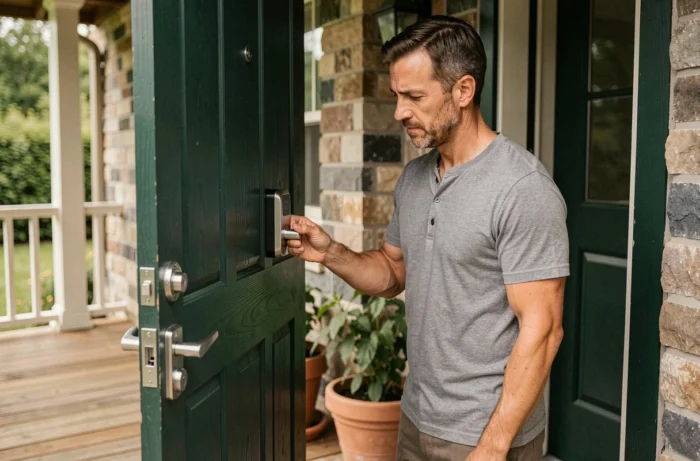
The front door rightly gets the most attention. An A2P-certified lock (with 1, 2 or 3 stars, depending on the level of resistance required) provides protection tested and rated by the National Center for Prevention and Protection. When replacing a lock, check the door frame and hinges too to avoid fitting a high-performance lock to a weak frame.
Ground-floor windows and French doors are a common blind spot. Burglar-resistant glazing (rated at least P2A) makes an intruder’s job much harder than standard double glazing. For more information on solutions suited to each room and layout, the resources from home by Serrurerie Auberge En Ville explain the technical options available.
Secondary access points are often overlooked: cellar doors, crawl-space hatches and sliding patio doors at the back of the house. A reinforcing lock on a side door costs little and can make a real difference.
Outdoor lighting and motion detection: deter intruders before they get in
Outdoor lighting around a home isn’t just about convenience. Dark areas around the property make it easier to scope out and approach discreetly. Installing motion-activated floodlights on the side and rear walls changes the risk calculation for a potential intruder.
The sensor you choose matters. A well-positioned passive infrared detector covers a wide area without being triggered by a passing cat. Adjust the sensitivity and timer to prevent false alarms that might eventually lead you to ignore the system.
Combine lighting with presence simulation
When a home is left unoccupied for several days—whether it’s a second home, a business trip or a vacation—smart home technology can be used to switch indoor lights on at varying times. This isn’t just a gimmick: burglary statistics also include second homes, and a property that appears empty for a long time can attract attention.
Varying the times lights come on from one day to the next makes the simulation more convincing than a simple fixed timer. Some smart controllers let you operate shutters, a radio and lights from a smartphone, without a professional monitoring subscription.
Everyday fire safety: maintain equipment, don’t just install it
You install a smoke detector, mentally tick the “fire safety” box, and don’t think about it again for years. That’s the problem. According to information published by Service-public.fr, the landlord installs the detector, but the occupant is responsible for maintaining it and replacing its battery.
Testing your smoke detector every three months takes ten seconds and helps ensure it will work when needed. It should be placed in the hallway serving the bedrooms, not in the kitchen, where false alarms from cooking can make it ineffective—or even lead to its removal out of frustration.
- Press the detector’s test button every three months to check the alarm and battery.
- Replace the battery or the entire detector according to the lifespan specified by the manufacturer (often printed on the back of the unit).
- Never paint over or obstruct the detection chamber, as this reduces its sensitivity to smoke.
- Install one detector on each floor of a multi-storey home, preferably on landings and in hallways.

Choosing an alarm system to suit your home and budget
Alarm and professional monitoring systems come in many different configurations. A three-room city-centre apartment has different needs from an isolated house with a garden and outbuildings.
Standalone alarm or monitored system with a subscription
A local alarm (siren and detectors) may be enough in a densely populated area, where the noise will quickly alert the neighbours. Professional monitoring makes sense when a home is isolated or left unoccupied for long periods: an operator receives the alert and can arrange a response.
Costs vary depending on the number of detectors, whether cameras are included and the type of subscription. Before signing, check that the system itself—not just the lock—is NF A2P certified, and review the cancellation terms for the monitoring contract.
Smart devices: useful additions, not standalone solutions
Wi-Fi cameras, video doorbells and connected door and window sensors can enhance security, but they don’t replace a complete alarm system. Their reliability depends on the quality of your Wi-Fi connection and how regularly their software is updated.
- Install outdoor cameras under cover to protect the lens from the weather and direct backlighting.
- Enable two-factor authentication in control apps to prevent video feeds from being hacked.
- Store recordings locally (on an SD card or NAS) as well as in the cloud, in case your internet connection goes down.
The performance of a connected door or window sensor can vary depending on the thickness of the frame and the material of the door (wood, PVC or aluminium). Test the position before permanently attaching the magnet.
Securing your home is less about accumulating equipment than about matching your chosen protections to your property’s actual vulnerabilities. A clear-eyed assessment of access points, well-planned outdoor lighting, a properly maintained smoke detector and an appropriately sized alarm system cover most everyday risks.